Most people judge a home by what it costs to build. I’ve learned to pay just as much attention to what it costs to own. Energy bills, maintenance, repairs, and replacements over 20 or 30 years usually add up to more than the line items that worry people during construction.
I’m Josh McMahon, and in 15 years of building custom homes across Central Virginia, the material and envelope choices we make during design are where a lot of that long-term cost is won or lost.
Sustainable, high-performance materials lower those ongoing costs by making a home more efficient, more durable, and easier to keep up. Here’s how that works, and which choices are worth the money.
Quick summary
Sustainable construction materials save money by cutting energy bills, reducing maintenance, lasting longer, and easing the load on your heating and cooling system. They can also make a home more appealing at resale. The biggest and most reliable savings come from the building envelope: insulation, air sealing, and the right windows.
- Lower energy bills from a tighter, better-insulated envelope
- Less maintenance and longer material life
- Less wear on your HVAC system
- Stronger appeal at resale
How sustainable construction materials lower your long-term costs
Here’s where the savings come from, in order of how much they matter.
Lower energy bills, the biggest lever
The envelope is where the money is. A tight, well-insulated home holds its temperature, so the HVAC runs less and your bills drop. The numbers back this up. The EPA’s ENERGY STAR program estimates that sealing and insulating alone save the average home about 15% on heating and cooling, or roughly 11% on total energy costs. Replacing old single-pane windows with high-performance, Low-E windows can lower energy bills by up to about 13%. And the U.S. Department of Energy reports that homes built to LEED standards use about 20 to 30% less energy than comparable conventional homes, with some saving up to 60%.
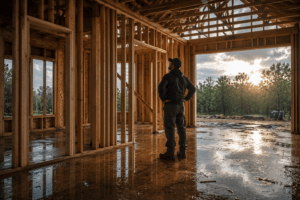
We build that performance in from the start. On our homes that means 2×6 exterior walls for a deeper insulation cavity, spray foam and AeroBarrier air sealing to close the gaps most homes leak through, an ERV system for fresh air without wasting conditioned air, and high-performance windows sized for Virginia’s climate. You’re not retrofitting any of it later, so you get the lower bills from the first month. You can see more about our approach to energy-efficient home design.
Less maintenance and longer life
Durable materials cost less to live with. Bamboo stands up to heavy wear and is rapidly renewable. Reclaimed wood reuses timber that has already proven it can last. Recycled-content products can match conventional materials for durability while diverting waste. Low-E glass holds up to sun and temperature swings without the wear cheaper glazing shows over time.
No single product does this on its own. What matters is choosing materials suited to your lot and climate, so you replace and repair less often over the decades you own the home.
Less strain on your HVAC
Your heating and cooling system is one of the most expensive things in the house to run and replace. When the envelope leaks, the HVAC works harder, runs longer, and wears out sooner. A tight, well-insulated home changes that. The system cycles less, holds comfort more evenly, and tends to last longer with fewer service calls. That’s a real cost most people never put on the spreadsheet.
Stronger appeal at resale
Efficiency shows up again when you sell. The Department of Energy notes that in many markets, green and energy-efficient homes sell faster and for more than comparable conventional homes. In Central Virginia, where buyers often weigh a resale home against a newer build, lower operating costs and a documented efficient envelope are an easy selling point. You spend less to own the home, and you hand the next owner the same advantage.
Common sustainable construction materials
You’ll come across plenty of environmentally friendly materials for construction once you start looking, and it’s easy to get lost in the options. Here are the green construction materials worth knowing for a custom home, and where each one tends to fit.
| Material | Why it’s considered sustainable | Common use |
| Reclaimed wood | Reuses existing timber instead of new harvest | Flooring, beams, accents |
| Bamboo | Grows back in a few years and wears well | Flooring, cabinetry |
| Recycled steel | Made largely from scrap and fully recyclable again | Framing, structural work |
| Recycled-content insulation | Made from recycled material with solid thermal value | Walls, attics |
| Cork | Renewable, with natural insulation and sound damping | Flooring, wall panels |
| Low-E glass | Cuts heat transfer to lower year-round energy use | Windows, doors |
You’ll also read about more innovative sustainable building materials like hempcrete, rammed earth, and straw-bale walls. They’re real and they have their place, but they show up mostly in specialty builds and rarely in custom homes around Central Virginia. I’m happy to talk through them, but I won’t point you toward a material that’s hard to service or finance here just because it’s trendy.
Across all of these, the materials that move your costs the most are the envelope ones: insulation, air sealing, and good glazing. That’s where we focus, because a tight building envelope saves more over the life of the home than any single eco-material on its own.
What about tax credits?
You may have read that building green earns you a federal tax credit. That changed. The One Big Beautiful Bill Act ended the main federal residential energy credits, the Energy Efficient Home Improvement Credit and the Residential Clean Energy Credit, for anything placed in service after December 31, 2025. So for 2026 there is no federal credit to count on for efficient materials or windows.
What’s still worth checking are state and local utility incentives, which vary by area and change over time. We keep an eye on what applies during planning so you don’t leave anything on the table. But I’d rather you budget on the energy savings, which are dependable, than on a credit that may not be there.
Where to start
The materials that save you money long-term are simple ones: a well-built envelope, durable finishes, and choices matched to your lot and Virginia’s climate. Get those right during design and the savings run for the life of the home.
That’s the part we handle. At McMahon Custom Homes, we help you weigh sustainable and high-performance materials during custom home construction so every choice fits your budget, your lot, and how long you plan to stay. If you own your lot and you’re ready to build, reach out for a consultation and we’ll talk through the options that make sense for your home.
Frequently asked questions
Do sustainable materials cost more to build with?
Some do upfront, some don’t. Spray foam and high-performance windows cost more than builder-grade versions, but the premium on a tight envelope is modest next to the overall build, and it pays back through lower energy bills over the years you own the home. Other choices, like reclaimed or recycled-content materials, can be close to cost-neutral. We price both the upfront and the long-term so you can decide with full information.
Which choices give the best payback?
The envelope, every time. Insulation, air sealing, and the right windows return more over the life of the home than almost any other green choice, because they cut a cost you would otherwise pay every month for decades.
Do energy-efficient homes really sell for more?
In many markets they sell faster and for more than comparable conventional homes, according to the Department of Energy. Lower operating costs and a documented efficient build are a straightforward advantage with buyers, especially against older resale homes.
What is the most environmentally friendly material?
It depends on the use. For low impact, rapidly renewable options like bamboo and reused materials like reclaimed wood are strong choices. The bigger environmental win, though, is usually a tight, efficient envelope that cuts energy use for the entire life of the home.