
A home engineered to use less energy from the start.
Every custom home we build is an opportunity to get the building envelope right from the beginning.
True energy efficiency does not come from one product or upgrade. It comes from insulation, air sealing, windows, ventilation, and HVAC systems working together as one complete system.
McMahon Custom Homes includes these decisions during Pre-Construction Planning rather than waiting until construction has already started.
We build energy-efficient custom homes across Goochland, Powhatan, Hanover, Richmond, Chesterfield, and Charlottesville. Every home is built on your land under a fixed-price contract.
A lot of homeowners focus on one feature, like spray foam or a high-SEER HVAC unit, and assume that’s what makes a home efficient. The reality is more layered. A high-performance home comes from several systems working together. We build all of these into the conversation starting at Pre-Construction Planning, before construction begins.
Insulation materials are selected and matched to the performance goals, design, and construction details of each individual home.
Dedicated air sealing closes small gaps and leaks that can weaken the performance of even well-insulated walls.
Windows are selected to perform well through Virginia’s wide temperature changes between hot summers and cold winters.
Insulation at the roof and foundation extends the building envelope from the top of the home to the bottom.
The heating and cooling system is sized and engineered specifically for the way the home is designed, sealed, and insulated.
ERV systems bring in fresh air while recovering conditioned energy.
Protects the wall assembly from mold and rot over time.
Leaks around plumbing lines, electrical wiring, windows, doors, and wall plates can weaken the performance of even a heavily insulated home. That is why air sealing is treated as a separate and dedicated step in every McMahon build.
For clients who place a higher priority on energy performance, available systems may include AeroBarrier whole-home envelope sealing and variable-speed HVAC equipment, such as the Trane XL17I. These systems can provide quieter operation and more precise temperature control.
A tightly sealed home also needs a controlled way to breathe. Without proper ventilation, stale air, cooking odors, and excess humidity can remain trapped inside.
Energy Recovery Ventilation systems continuously bring fresh outdoor air into the home while recovering energy from the indoor air being replaced. This gives the home better air exchange without wasting as much of the energy already used for heating or cooling.
For families affected by allergies or asthma, improved indoor-air quality may be more noticeable in daily life than the reduction in the utility bill.
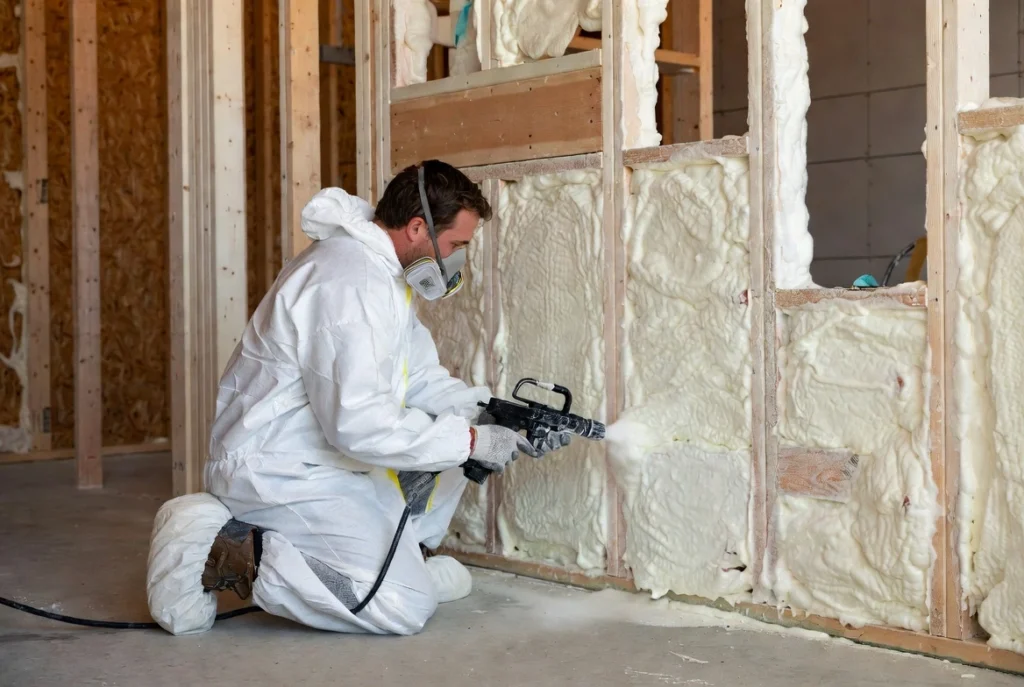
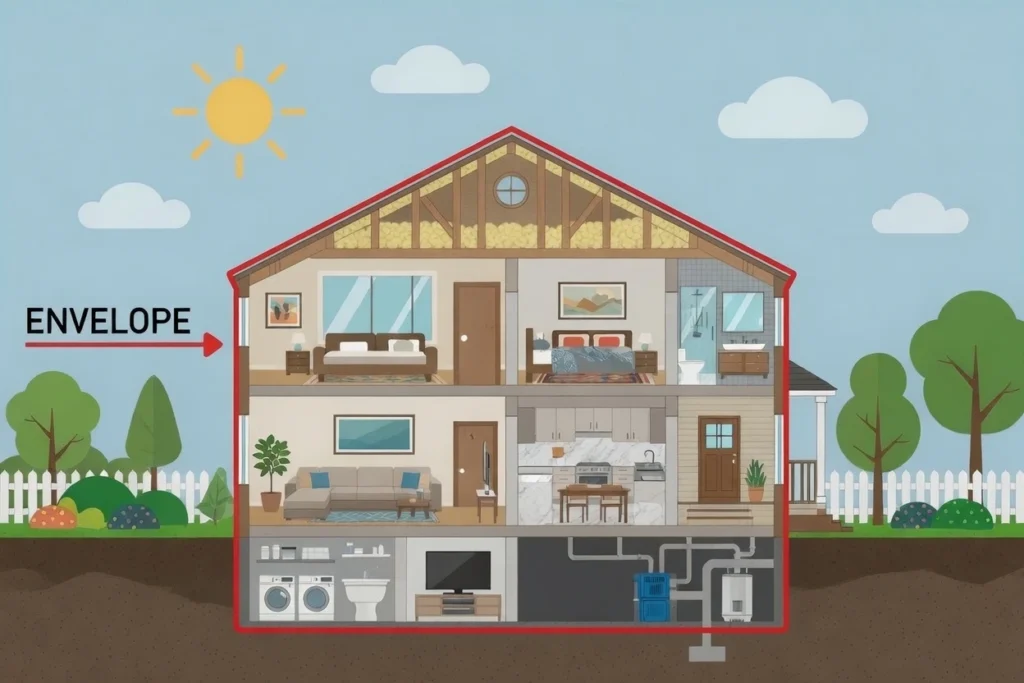
We match the insulation strategy to the performance goals of each project rather than using the same material in every home.
Our building-envelope approach may include comprehensive air sealing before insulation is installed, closed-cell spray foam in critical areas where higher air-sealing performance is needed, ROCKWOOL or BIBS insulation in wall cavities, and open-cell spray foam along the roof deck.
Applying insulation along the roof deck can create a conditioned attic. This keeps HVAC equipment away from summer attic temperatures that can rise above 130°F. The result is less strain on the heating and cooling system and more consistent comfort in the rooms below.
Moisture control is just as important as temperature control in Virginia’s climate. Materials such as closed-cell spray foam and ROCKWOOL can resist water and retain their shape over time. This helps protect wall assemblies from mold and rot long after the drywall is installed.
The wall-framing decision, including whether to use 2×4 or 2×6 framing, is also considered as part of the complete building-envelope strategy.
Energy-efficient windows matter more in Virginia than in milder climates, given how much our temperatures swing between summer and winter. Beyond insulation and windows, smart home upgrades like programmable thermostats, lighting controls, and whole-home monitoring give you day-to-day control over how your home uses energy, on top of a more efficient shell to work with.
High-efficiency systems cost more upfront. Where they pay off is in the years after move-in: lower monthly utility bills, fewer HVAC repairs, and a more comfortable home in both Virginia’s humid summers and cold, damp winters. Some of the payoff shows up in ways homeowners don’t expect going in. A well-sealed, well-insulated home is noticeably quieter, since less outside noise makes it through the walls and windows.
WE’LL SHOW YOU WHERE THE RETURN IS REAL.
High-efficiency systems cost more upfront. Where they pay off is in the years after move-in: lower monthly utility bills, fewer HVAC repairs, and a more comfortable home in both Virginia’s humid summers and cold, damp winters. Some of the payoff shows up in ways homeowners don’t expect going in. A well-sealed, well-insulated home is noticeably quieter, since less outside noise makes it through the walls and windows.
WE’LL SHOW YOU WHERE THE RETURN IS REAL.

Either option can meet building-code requirements, but 2x6 framing provides roughly two additional inches of wall-cavity depth compared with standard 2x4 framing.
That extra depth can hold more insulation, reduce outside noise, and provide additional structural capacity for larger spans or more complex rooflines.
The tradeoff is a higher upfront cost for lumber and insulation. For many homeowners planning to stay in their Virginia home for the long term, the additional performance can be worthwhile. The right choice still depends on your design, budget, and priorities.
For many homeowners, spray foam can be a worthwhile investment.
It can improve air sealing, increase comfort, and help reduce energy costs over time. However, it generally costs more than fiberglass batt insulation.
Whether spray foam is the right choice depends on your home’s design, the specific part of the building where it will be used, and the level of air-sealing performance you want to achieve.
Air sealing closes the small gaps and leaks around plumbing, wiring, windows, doors, wall plates, and other penetrations where conditioned indoor air can escape and outdoor air can enter.
Insulation slows heat transfer, but insulation alone does not stop air movement. A home can have substantial insulation and still perform poorly when it has not been properly air sealed.
McMahon treats air sealing as its own dedicated construction step, separate from framing and insulation.
It depends on what you want to optimize.
Closed-cell spray foam has a higher insulation value per inch, typically around R-6.5 to R-7.0, compared with approximately R-3.2 to R-3.8 for fiberglass batt. Closed-cell spray foam can also function as an air barrier, while fiberglass does not stop air movement on its own.
Fiberglass generally costs less upfront. In many homes, both materials can be used together: spray foam in critical areas and other insulation materials in wall cavities, depending on where each product performs best.
These four FAQs retain the technical comparisons, R-values, air-sealing explanation and framing guidance in the document.
We’re a veteran-owned, locally owned builder based in Goochland, and Josh has spent close to two decades building homes across this market. Every build goes through the same Pre-Construction Planning process, where the building envelope gets designed alongside the floor plan, not decided after the fact. One team carries your home from that first conversation through your one-year warranty.
If you’re set on a specific style rather than energy performance as the starting point, we also build luxury custom homes, barndominiums, and ADUs across Goochland, Powhatan, Hanover, Richmond, Chesterfield, Henrico, and Charlottesville.
Let’s talk through your land, your goals, and which insulation, air-sealing, HVAC, ventilation, window, and smart-home systems are worth the investment for your project.