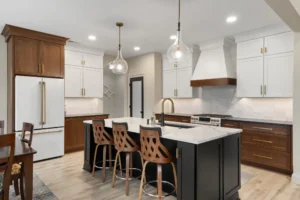
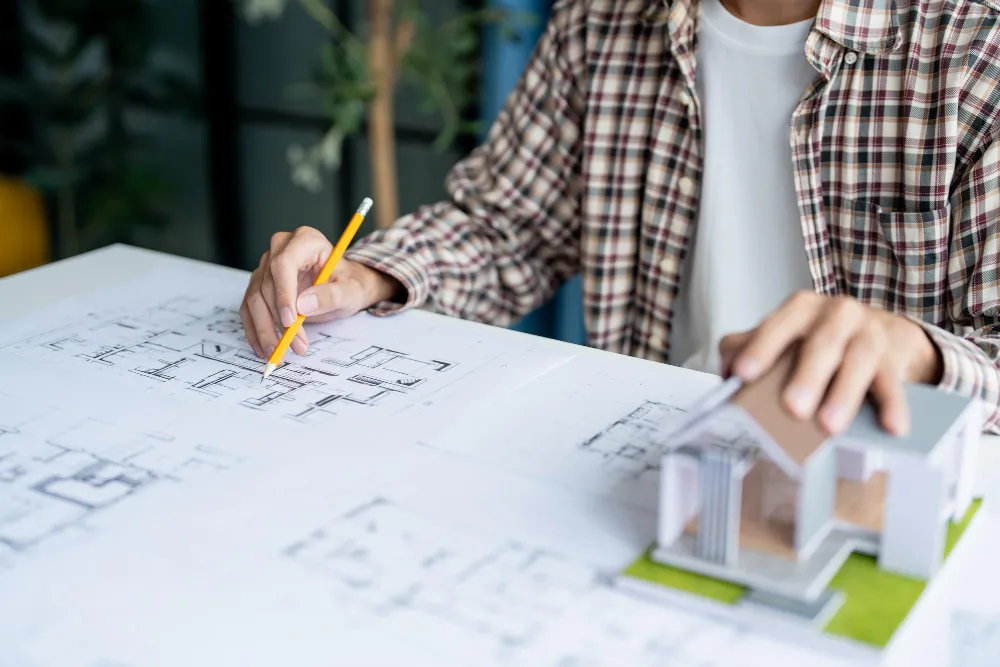
Tour two interior model homes in central Virginia and “modern” can mean two completely different things. The first is bright white kitchens and stark right angles. The next has deep walnut, warm brass, and curved transitions. Both call themselves modern. Both are right, technically.
We’ve been building custom homes in the greater Richmond area for over fifteen years. Some of the trends that came through in that time turned into permanent standards. Others quietly disappeared. The list below covers the modern home design trends for custom builds in 2026 that we think will hold up, with notes on why and on what they actually look like in practice.
Quick Summary
Modern home design trends for custom builds in 2026 are warmer and more intentional than the minimalism that dominated the 2010s. Honed natural stone, white oak cabinetry, multi-generational suites, main-floor primary living, walk-in sculleries, spa-grade primary baths, smart home wiring baked in at the framing stage, and tight building envelopes are all leading the way. The strongest design choices fit the way you live now and the way you’ll still want to live in twenty years.
What “Modern” Really Means in Custom Homes Right Now
For most of the last decade, modern in custom homes meant white walls, gray floors, right angles, and the kind of stark minimalism that photographs beautifully in a magazine and feels cold to actually live in. That version of modern is fading.
The custom homes we’re framing in Goochland and Powhatan this year still have clean lines and open layouts. The palette is warmer and the materials feel more grounded, with architecture carrying more of the design weight than decoration.
You can see the shift the moment you walk into a recently finished interior model home around central Virginia. Cabinet tones are softer, stone surfaces show natural variation instead of polished shine, and brass and bronze now sit next to matte black instead of replacing it. Curves and arches are also returning in transitions and built-ins, after a decade of strict geometry.
Top Modern Home Design Trends for Custom Builds in 2026
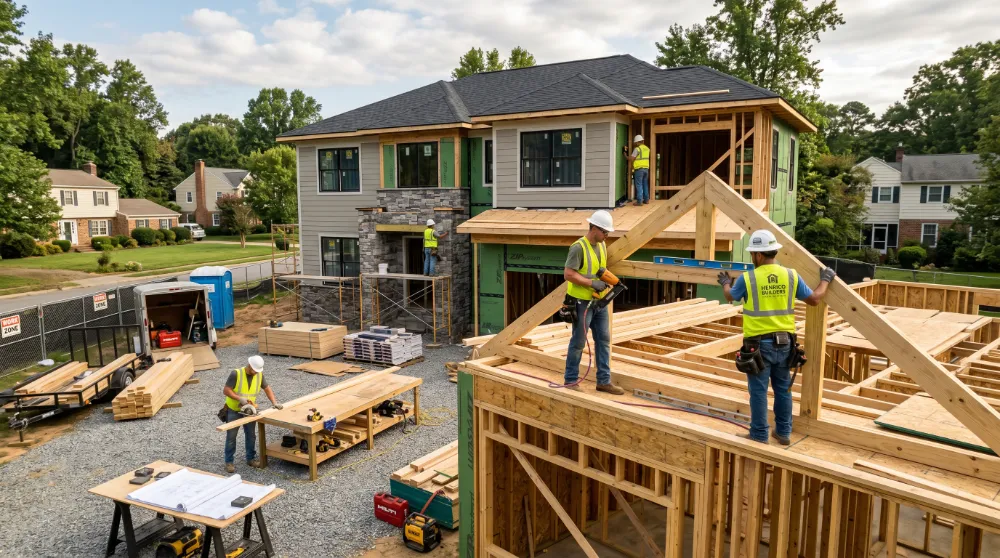
These are the trends we keep building into custom homes across Goochland, Powhatan, Hanover, Chesterfield, Henrico, and Charlottesville. Each one is a unique custom home feature that elevates house design with staying power deeper than the typical Pinterest trend cycle.
1. Warmer, More Grounded Color Palettes
The bright-white kitchens that defined custom builds for a decade are giving up ground. Mushroom, taupe, muted greens, stained wood. Warm neutrals with depth are showing up everywhere from kitchens to primary baths to mudrooms.
The shift is about how the home feels at every hour of the day. White-on-white and gray-on-gray look sharp at the first walk-through. By the third week of living in the house, they start to read flat and cold under Virginia’s mid-afternoon light. Warmer tones hold up across changing daylight and feel calm instead of clinical.
2. Honed Natural Stone and Quieter Surfaces
High-gloss stone is on the way out. Honed quartzite, leathered finishes, and softly veined marble are leading custom builds in 2026 because they have presence without theater.
Visual energy comes from natural movement and texture more than from shine. The effect works especially well in Virginia daylight, which runs strong from late morning through early evening for most of the year. A polished stone wall under that light becomes a flashbulb. The same stone honed reads as depth.
Honed and leathered surfaces also hide water spots and fingerprints better than polished ones, which matters in a kitchen island that gets used three meals a day. The same approach is shaping porcelain choices, which are trending toward matte and softly textured rather than mirror-glazed.
3. White Oak Cabinetry in Warm Neutral Tones
White oak has become the default wood in modern custom homes, and the popularity isn’t slowing down. The grain reads clean enough for contemporary spaces while still adding warmth that walnut or maple can’t quite match. That balance is why white oak keeps winning the cabinet conversation.
Walnut still shows up where we want more richness, often in libraries, studies, and primary bath vanities. Lower-sheen finishes are also gaining ground over glossy clear coats, since gloss reads dated faster than matte and satin.
The combination we keep building is a painted perimeter in a warm neutral, paired with a stained white oak island. The pairing gives the kitchen depth and texture without forcing a single color story across every surface. It also photographs well, which most homeowners now care about whether they admit it or not.
4. Multi-Generational Suites and Dual Primary Bedrooms
Multi-gen has moved from a niche request to a core part of our custom builds over the last three years. The version we’re being asked to design now combines a second primary suite with a kitchenette, in-suite laundry, and a separate or lockable entry from the rest of the house.
The layout works whether you’re planning for aging parents, adult children moving back, or long-stay guests. The National Association of Home Builders’ annual What Home Buyers Really Want studies have flagged multi-gen layouts as one of the fastest-growing buyer requests over the last five years.
Soundproofing is the detail people forget until they don’t have it. Insulated interior walls and resilient channels keep one household from hearing the other, which makes the difference between a guest room and a true suite. We specify this from the start on every multi-gen layout, and it’s especially common on our Goochland and Powhatan builds where lot sizes make the second-suite footprint easier to add.
5. Main-Floor Primary Living With Universal-Design Touches
Main-floor primary suites are becoming the default in new custom homes for buyers of every age. A first-floor primary, first-floor laundry, wider doorways, and a curbless walk-in shower work for families across decades.
The trick is integrating these features so they read as design choices rather than accessibility installations. Curbless showers can be the most beautiful element in a primary bath when they’re planned from the framing stage. Bolted in after the fact, they always look bolted in.
The buyers driving this trend hardest are in their 40s and 50s, planning to stay in the home for thirty years. The same features serve guests with mobility needs, which is why most of our recent Powhatan and Hanover builds include some version of this even when the homeowners are decades away from needing it.
6. Sculleries, Prep Kitchens, and Serious Pantries
The kitchen is growing a second layer. Sculleries, prep kitchens, and walk-in pantries are showing up in almost every higher-end custom build we’re framing in central Virginia. The driver is open-concept living: dinner guests can see straight into the working area of the kitchen, and most people don’t want the sink full of dishes on display.
A scullery hides the working mess. It usually holds a second sink, a dishwasher, extra storage, sometimes a second range, and often a coffee or beverage station. The investment pays off the first time you host a real dinner party and the guests still see a clean island while you actually cook.
Walk-in pantries have grown too. We’re framing them with counter space, outlets for stand mixers and small appliances, and sometimes a dedicated freezer. The pantry has become a small room rather than a closet.
7. Spa-Grade Primary Baths and Dedicated Wellness Rooms
The primary bath has graduated from trendy upgrades to full wellness design. Spa-grade is the request we hear constantly. The specs that come with that request:
- Steam shower readiness (vapor-proofed walls and a dedicated drain)
- A soaking tub with proper structural support and dedicated supply
- Heated floor circuits zoned to the bathroom
- Layered lighting on separate dimmer circuits
- Exhaust ventilation rated for the actual moisture load rather than a builder-grade fan
Beyond the bath, dedicated wellness rooms are landing in more builds. Home gyms need reinforced floor framing for heavy equipment. Saunas and cold plunges need pre-planned electrical and plumbing rough-ins. We plan these at the framing stage now instead of trying to add them after drywall is up.
Common 2026 wellness-room additions:
- Reinforced flooring for home gym equipment
- Pre-planned sauna and cold plunge connections
- Yoga or meditation rooms with acoustic insulation
- Ventilation specified for air quality rather than just code minimum
8. Smart Home Integration Done at the Framing Stage
Smart home features are moving from afterthought to framing-stage decisions. The reason is straightforward: structured wiring, conduit pulls, low-voltage planning, and circuit allowances are easy to get right when the walls are open and almost impossible to retrofit later without tearing them back out.
The smart features that need framing-stage planning:
- Whole-home structured wiring for networking and media
- Conduit between key rooms and the equipment closet so future tech upgrades don’t require demolition
- Low-voltage runs to lighting control, shades, security, and AV touch points
- A dedicated 50-amp 240V circuit in the garage for EV charging (with capacity for a second vehicle later)
- Climate control zones planned around how rooms are actually used
- Camera and access-control rough-ins to avoid surface-mounted cables later
The hardware itself is also calming down. Touchscreens now tuck into cabinets or closets, and most newer systems run through phone or voice instead of wall-mounted panels. The home feels quiet rather than looking like a control room.
9. Energy-Tight Building Envelopes
This is the trend that doesn’t show up in photos and has the longest payback in the house. A tight building envelope is what makes the difference between a custom home that feels comfortable and one that feels expensive to run.
The spec we’re using on most of our 2026 builds:
- 2×6 framed exterior walls instead of 2×4, giving more cavity for insulation
- R-60 attic insulation (above current Climate Zone 4 code, which calls for R-49 in our part of Virginia)
- Continuous exterior insulation under the cladding
- Air sealing at every penetration: top plates, rim joists, electrical boxes, plumbing
- An ERV (energy recovery ventilator) or HRV that brings in filtered fresh air without losing conditioned air
The combination cuts monthly utility costs significantly and meaningfully improves indoor air quality. ENERGY STAR-certified custom homes typically use 15-30% less energy than code-minimum builds. The construction premium is modest, the payback runs over years rather than decades, and the comfort difference is something you feel from the day you move in.
Designing a Modern Custom Home in Central Virginia
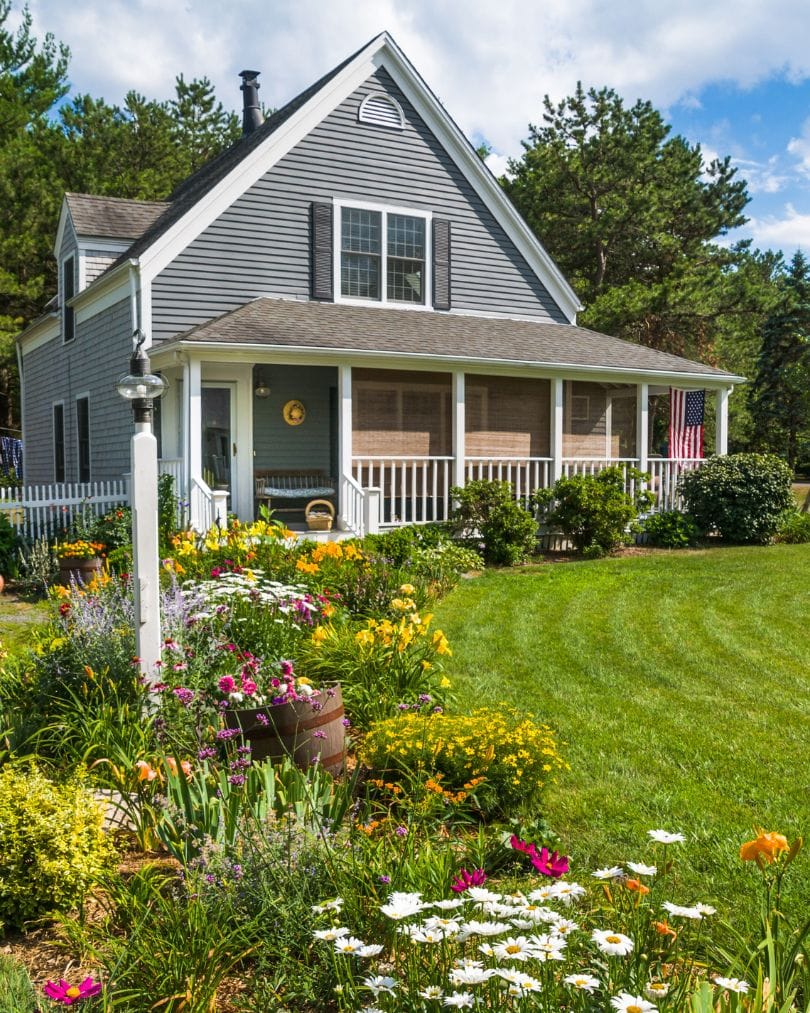
The strongest design choices fit the life you’re planning to live in the house. They also tend to hold their value if you ever do decide to sell. Most of the trends above are easier to specify at the framing stage than to retrofit later, especially the structural ones: multi-gen layouts, main-floor primary suites, scullery walls, smart home conduit, and a tight building envelope.
McMahon Custom Homes builds on your lot across central Virginia (Goochland, Powhatan, Hanover, Chesterfield, Henrico, and Charlottesville), and we also have move-in-ready spec homes available periodically. We’re veteran-owned and family-operated, working on cost-plus contracts that keep the budget transparent from foundation through final walkthrough.
If you’re planning a custom build in 2026 or want to walk through any of these trends on a real floor plan, send us a note. We’ll show you what they actually look like in practice. Contact us today and let’s plan your modern home design.
Frequently Asked Questions
What are the latest modern home design trends for custom builds?
The 2026 trends lean warmer and more intentional than past minimalism. Honed natural stone, white oak cabinetry, multi-generational suites, main-floor primary living, walk-in sculleries, spa-grade primary baths, smart home wiring at the framing stage, and tight building envelopes are all leading the way. Calm, grounded materials are replacing high-contrast, high-shine finishes across the board.
Are open-concept floor plans still popular in custom homes?
Open-concept layouts are still popular but with refinements. People still want openness between the kitchen, dining, and living areas, and they also want defined zones for quieter activities. The scullery or prep kitchen is part of this shift. It hides the working mess so the main kitchen stays open without feeling cluttered.
Are energy-efficient custom homes worth the investment?
Energy-efficient homes typically pay back over years through lower utility bills and meaningfully better comfort. The specs that matter most are 2×6 framed walls, R-60 attic insulation, continuous exterior insulation, careful air sealing, and an ERV or HRV ventilation system. The construction premium is modest, and the indoor air quality improvement is immediate.
What mistakes should homeowners avoid when building a custom home?
The most common ones we see: skipping pre-construction planning, choosing a builder by lowest bid rather than clearest scope, ignoring lot conditions before purchase, and delaying long-lead-time finish selections until the schedule is already tight. Most of these are budget and timeline mistakes that show up months into construction, when they’re expensive to fix.
What luxury features are becoming standard in modern custom homes?
Several features that used to be luxury upgrades are now expected in higher-end custom builds. Walk-in sculleries, room-sized primary closets, dual home offices, spa-quality primary baths with steam and heated floors, dog wash stations, EV-ready electrical, and multi-slide door systems are all moving into the standard-feature category in our central Virginia builds.
What interior color trends are dominating modern custom homes?
Warmer, earthier palettes are leading the conversation. Mushroom, soft taupe, muted greens, and stained wood are replacing the bright white kitchens and gray-on-gray interiors that defined the last decade. The shift is toward colors that read calm under both daylight and evening lighting, holding up across the full day.