
One of the most important decisions you’ll make when building a custom home is one you’ll never see after move-in.
It’s the insulation hidden behind your drywall.
The insulation system you choose affects your home’s comfort, monthly utility bills, indoor air quality, sound control, moisture management, and long-term durability. While many homeowners focus on finishes like cabinets and flooring, insulation is one of the biggest factors in how your home performs every day.
So what is the best insulation for a new home?
The answer depends on your priorities. Every insulation product has strengths, and understanding the differences will help you make an informed decision before construction begins.
Insulation slows the transfer of heat between the inside and outside of your home.
A properly insulated home helps:
However, insulation is only one part of a high-performance home. Air sealing, moisture management, ventilation, windows, and HVAC design all work together to create an efficient and comfortable home.
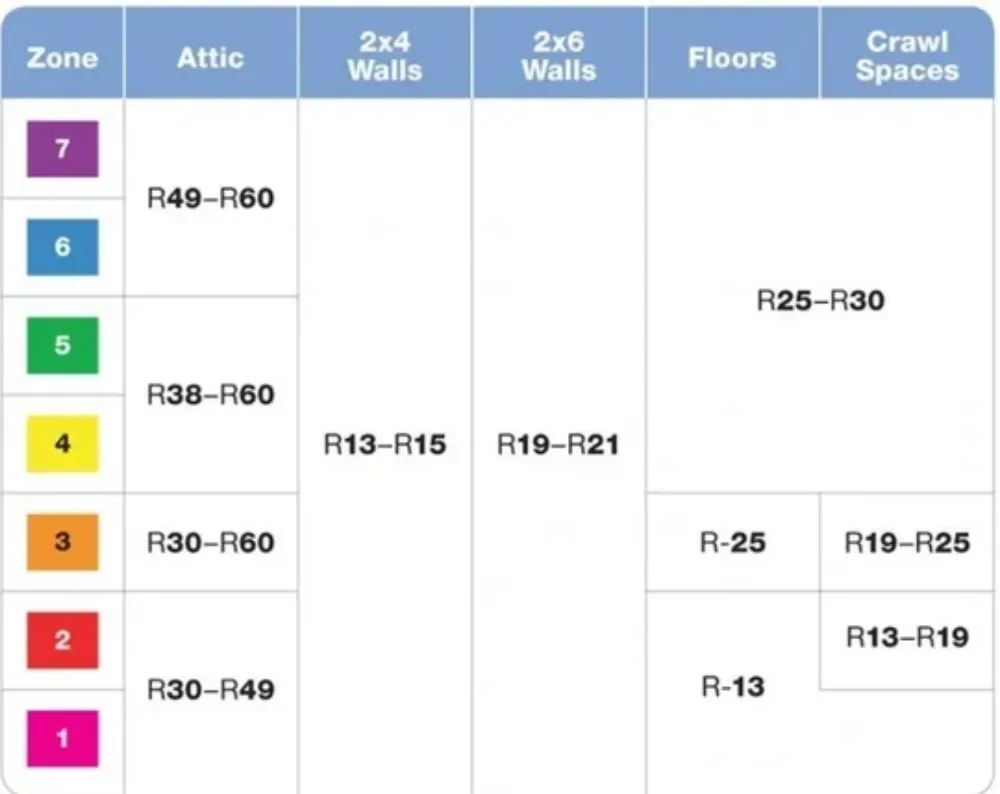
R-value measures how well insulation resists heat flow.
Generally speaking, the higher the R-value, the better the insulation resists heat transfer.
While R-value is important, it is not the only factor. Proper installation and air sealing often have just as much impact on your home’s overall performance.
Fiberglass batt insulation is the most common insulation found in homes today.
It comes in pre-cut sections that fit between wall studs and ceiling joists.
Fiberglass batts must be carefully cut around:
If gaps, compression, or voids occur during installation, the insulation’s effectiveness decreases.
Fiberglass also does not stop air movement, so proper air sealing is still required.
ROCKWOOL insulation is manufactured from natural stone and recycled materials. It has become increasingly popular in custom homes because of its excellent fire resistance, sound control, and moisture performance.
Many homeowners immediately notice the improved sound control that ROCKWOOL provides, making it an excellent choice for bedrooms, home offices, media rooms, and exterior walls.
ROCKWOOL typically costs more than fiberglass batt insulation.
Like fiberglass, it is not an air barrier and should always be paired with proper air sealing.
BIBS is a dense fiberglass insulation system that is blown into wall cavities behind a mesh fabric.
Unlike traditional batt insulation, it completely fills the cavity around wiring, plumbing, and framing.
BIBS is not an air barrier.
For maximum performance, it should be combined with a comprehensive air-sealing strategy.
Open-cell spray foam expands dramatically after application and seals small gaps throughout the building envelope.
It is commonly installed on the underside of roof decking to create a conditioned attic.
Open-cell spray foam has a lower R-value per inch than closed-cell spray foam.
Because it is vapor permeable, moisture management should always be considered as part of the home’s overall design.
Closed-cell spray foam provides one of the highest R-values per inch available in residential construction.
It also functions as both an insulation system and an air barrier.
Closed-cell spray foam is one of the more expensive insulation options, which is why many builders use it strategically rather than throughout the entire home.
| Insulation Type | Air Sealing | R-Value Per Inch | Sound Control | Moisture Resistance | Fire Resistance | Relative Cost |
|---|---|---|---|---|---|---|
| Fiberglass Batt | Low | R-3.2 to R-3.8 | Fair | Low | Good | $ |
| ROCKWOOL | Low | R-4.0 to R-4.3 | Excellent | Excellent | Excellent | $$ |
| BIBS | Low | R-4.2 to R-4.7 | Good | Low | Good | $$ |
| Open-Cell Spray Foam | Excellent | R-3.6 to R-4.0 | Very Good | Moderate | Good | $$$ |
| Closed-Cell Spray Foam | Excellent | R-6.5 to R-7.0 | Good | Excellent | Good | $$$$ |
There isn’t one insulation product that’s perfect for every home.
Instead, choose the insulation that aligns with your priorities.
One of the biggest misconceptions in homebuilding is that adding more insulation automatically creates a more efficient home.
It doesn’t.
Air leaks around:
can dramatically reduce your home’s energy performance.
That’s why professional air sealing is one of the most important steps in building a high-performance home.
Traditionally, insulation was installed on the attic floor.
Today, many high-performance homes insulate the underside of the roof deck instead.
This creates a conditioned attic, which offers several advantages:
Instead of exposing your HVAC system to attic temperatures exceeding 130°F during the summer, your equipment operates within a much more controlled environment.
At McMahon Custom Homes, we believe there isn’t a single insulation product that’s best for every application.
Instead, we combine products where they perform best.
Our high-performance building envelope may include:
This layered approach helps improve comfort, reduce energy costs, minimize outside noise, improve indoor air quality, and create a home designed to perform for generations.
For many homeowners, yes. Spray foam improves air sealing, increases comfort, and can lower long-term energy costs. Whether it’s the right choice depends on your home’s design and your performance goals.
ROCKWOOL offers better sound control, greater fire resistance, and improved moisture performance than traditional fiberglass batt insulation. It typically comes at a higher initial cost.
BIBS provides more complete cavity coverage because it fills around wiring and plumbing rather than relying on pre-cut batts. Both products can perform well when properly installed.
Focusing only on R-value.
Proper installation, air sealing, moisture management, ventilation, and HVAC design all work together to determine how your home performs over time.
The insulation hidden behind your drywall will affect your comfort every day you live in your home.
At McMahon Custom Homes, we believe homeowners deserve to understand how their home is built, not just what it looks like. Through our Land-to-Keys™ process, we explain how insulation, air sealing, windows, ventilation, and HVAC systems work together to create a healthier, quieter, and more energy-efficient home.
If you’re planning to build a custom home in Goochland, Richmond, Chesterfield, Midlothian, Henrico, Hanover, Powhatan, or the surrounding areas, we’d be happy to help you compare insulation options and design a building envelope that supports your family’s lifestyle for decades to come.